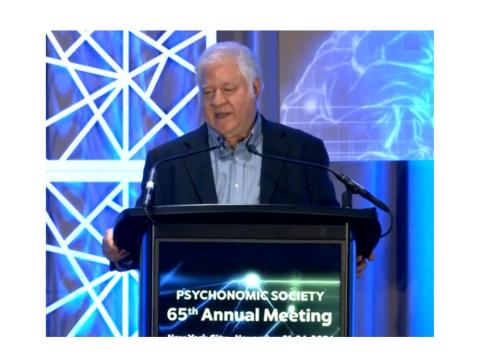
- Working memory, the small amount of information held in mind
- How much can be held in working memory
- How the amount in working memory can be measured
- Childhood development of working memory
- The role of selective attention in working memory
- Life span development of working memory
- Consciousness and its relation to working memory
B.S. University of Michigan, 1973
Ph.D. University of Wisconsin, 1980
Postdoctoral Fellowship at NYU, 1981-82
Curators' Distinguished Professor, Department of Psychological Sciences, University of Missouri
Curators' Distinguished Professor Emeritus, University of Missouri (since November, 2025)
Books:
Logie, R.H., Wen, Z., Gathercole, S., Cowan, N., & Engle, R. (Eds.) (2023), Memory in Science for Society: There is nothing as practical as a good theory. Oxford University Press.
Courage, M.L., & Cowan, N. (eds) (2022). The development of memory in infancy and childhood. 2nd Edition. Routledge.
Logie, R.H., Camos, V., & Cowan, N. (eds) (2021). Working Memory: State of the Science, Oxford University Press.
Cowan, N. (2016). Working memory capacity. Psychology Press and Routledge Classic Edition. New York: Routledge. [Original edition 2005. New Foreword to the Classic Edition.]
Courage, M.L., & Cowan, N. (eds.) (2009). The development of memory in infancy and childhood. Hove, U.K.: Psychology Press.
Cowan, N. (2005). Working memory capacity. Hove, East Sussex, UK: Psychology Press. [Psychology Press and Routledge Classic Edition with new foreword, 2016]
Cowan, N. (ed.) (1997). The development of memory in childhood. Hove, East Sussex, UK: Psychology Press. (Paperback edition: 1997)
Cowan, N. (1995). Attention and memory: An integrated framework. Oxford Psychology Series, No. 26. New York: Oxford University Press. (Paperback edition: 1997)
Selected Journal Articles
(for a complete list see C.V. attached at top of web page)
Approximate reverse chronological order
Bao, C., Li, Y., & Cowan, N. (2025). Object- and feature-based working memory limits for pairs of complex objects and their development during the school years. Cognition, 262, 106163. https://doi.org/10.1016/j.cognition.2025.106163
Gaspelin, N., & Cowan, N. (2025). Restoring a top-down control assumption: salience effects in working memory are overcome with time. Journal of Experimental Psychology: General, 154 (8), 2301-2317. https://doi.org/10.1037/xge0001776
Cowan, N., & Guitard, D. (2025). Similar working memory outcomes with successive versus concurrent presentation of tones and colors. Attention, Perception & Psychophysics, 87, 884–898. https://doi.org/10.3758/s13414-025-03036-3
Forsberg, A., Guitard, D., Greene, N.R., Naveh-Benjamin, M., & Cowan, N. (2025). Differential information transfer and loss between working memory and long-term memory across serial positions. Journal of Experimental Psychology: Learning, Memory, and Cognition, 51(8), 1191–1212. https://doi.org/10.1037/xlm0001437
Cissne, M.N., Bellesheim, K.R., Cowan, N., & Christ, S.E. (2024). Visual working memory in adolescents with autism spectrum disorder. Journal of Autism and Developmental Disorders. Online ahead of print. doi: 10.1007/s10803-024-06600-2
Cowan, N., Ahmed, N.I., Bao, C., Cissne, M.N., Flores, R.D., Gutierrez, R.M., Hayse, B., Musich, M.L., Nourbakhshi, H., Nuraini, N., Schroeder, E.E., Sfeir, N., Sparrow, E., & Superbia-Guimarães, L. (2025). Theories of consciousness from the perspective of an embedded processes view. Psychological Review, 132(1), 76-106. https://doi.org/10.1037/rev0000510
Cowan, N., & Guitard, D. (2024). Encoding colors and tones into working memory concurrently: A developmental investigation. Developmental Science, e13552. https://doi.org/10.1111/desc.13552
Greene, N., Forsberg, A., Guitard, G., Naveh-Benjamin, M., & Cowan, N. (2024). A lifespan study of the confidence-accuracy relation in working memory and episodic long-term memory. Journal of Experimental Psychology: General, 153, 1336–1360. https://doi.org/10.1037/xge0001551
Superbia-Guimarães, L., & Cowan, N. (2023). Disentangling processing and storage accounts of working memory development in childhood. Developmental Review, 69, 101089. https://doi.org/10.1016/j.dr.2023.101089
Cowan, N., Bao, C., Bishop-Chrzanowski, B.M., Costa, A.N., Greene, N.R., Guitard, D., Li, C., Musich, M.L., & Ünal, Z.E. (2024). The relation between attention and memory. Annual Review of Psychology, 75, 183-214. https://doi.org/10.1146/annurev-psych-040723-012736
Naveh-Benjamin, M. & Cowan, N. (2023). Age-related changes in working memory: Roles of attention, executive function, and knowledge. Nature Reviews Psychology, 2, 151-165. https://doi.org/10.1038/s44159-023-00149-0. Viewable Link: https://rdcu.be/c39GP
Guitard, D., & Cowan, N. (2023). The tradeoff between item and order information in short-term memory does not depend on encoding time. Journal of Experimental Psychology: Human Perception and Performance, 49, 51–70. https://doi.org/10.1037/xhp0001074 [Editor’s Choice Award]
Barton, A.U., Valle-Inclán, F., Cowan, N., & Hackley, S. (2022). Unconsciously registered items reduce working memory capacity. Consciousness and Cognition, 105, 103399
Li, Y., & Cowan, N. (2022). Constraints of attention, stimulus modality, and feature similarity in working memory. Attention, Perception, & Psychophysics, 84, 2519–2539. https://doi.org/10.3758/s13414-022-02549-5
Guitard, D., & Cowan, N. (2023). Attention allocation between item and order information in short-term memory. Quarterly Journal of Experimental Psychology 76(6): 1391–1409. DOI: 10.1177/17470218221118451
Forsberg, A., Guitard, D., Greene, N.R., Naveh-Benjamin, M., & Cowan, N. (2022). The proportion of working memory items recoverable from long-term memory remains fixed despite adult aging. Psychology and Aging, 37, 777-786. https://doi.org/10.1037/pag0000703
Forsberg, A., Adams, E.J., & Cowan, N. (2023). Why does visual working memory ability improve with age: More objects, more feature detail, or both? A registered report. Developmental Science, 26, e13283, 1-18. DOI: 10.1111/desc.13283
Cowan, N., & Elliott, E.M. (2023). Deconfounding serial recall: Response timing and the overarching role of grouping. Journal of Experimental Psychology: Learning, Memory, and Cognition, 49, 249-268. http://dx.doi.org/10.1037/xlm0001157
Cowan, N. (2022). Working memory development: A 50-year assessment of research and underlying theories. Cognition, 224, 105075. doi.org/10.1016/j.cognition.2022.105075
Ünal, Z.E., Forsberg, A., Geary, D.C., & Cowan, N. (2022). The Role of Domain-General Attention and Domain-Specific Processing in Working Memory in Algebraic Performance: An Experimental Approach. Journal of Experimental Psychology: Learning, Memory, and Cognition, 48, 348-374. https://doi.org/10.1037/xlm0001117
Gray, S., Levy, R., Alt, M., Hogan, T.P., & Cowan, N. (2022). Working memory predicts new word learning over and above existing vocabulary and nonverbal IQ. Journal of Speech, Language, and Hearing Research, 65, 1044–1069. https://doi.org/10.1044/2021_JSLHR-21-00397
Guitard, D., Saint-Aubin, J., & Cowan, N. (2022). Tradeoffs between item and order information in short-term memory. Journal of Memory and Language, 122, 104300. https://doi.org/10.1016/j.jml.2021.104300
Belletier, C., Doherty, J., Jaroslawska, A., Rhodes, S., Cowan, N., Naveh-Benjamin, M., Barrouillet, P., Camos, V., & Logie, R. (2023). Strategic adaptation to dual-task in verbal working memory: Potential routes for theory integration. Journal of Experimental Psychology: Learning, Memory, and Cognition, 49, 51–77. doi: 10.1037/xlm0001106.
Forsberg, A., Adams, E.J., & Cowan, N. (2021). The Role of Working Memory in Long-Term Learning: Implications for Childhood Development. Psychology of Learning and Motivation, 74, 1-45.
Forsberg, A., Guitard, D., Adams, E. J., Pattanakul, D., & Cowan, N. (2022). Children's long-term retention is directly constrained by their working memory capacity limitations. Developmental Science, 25 (2), e13164. https://doi.org/10.1111/desc.13164 [Developmental Science Early Career Researcher Prize, 2021]
Cowan, N., Guitard, D., Greene, N.R., & Fiset, S. (2022). Exploring the use of phonological and semantic representations in working memory. Journal of Experimental Psychology: Learning, Memory, and Cognition, 48, 1638–1659.
Cowan, N., & Hardman, K.O. (2021). Immediate recall of grouped serial numbers with or without multiple item repetitions. Memory, 29(6), 744-761 doi.org/10.1080/09658211.2021.1942920
Forsberg, A., Blume, C., and Cowan, N. (2021). The development of metacognitive accuracy in working memory across childhood. Developmental Psychology, 57, 1297-1317. DOI: 10.1037/dev0001213
Elliott, E.M., Morey, C.C., AuBuchon, A.M., Adams, E. Attwood, M., Bayram, B., Beeler, S., Blakstvedt, T., Büttner, G., Castelain, T., Cave, S., Cowan, N. et al. (2021). Multi-lab direct replication of Flavell, Beach and Chinsky (1966): Spontaneous Verbal Rehearsal in a Memory Task as a Function of Age. Advances in Methods and Practices in Psychological Science, 4 (2), 1-20.
Cowan, N. (2021). Differentiation of two working memory tasks normed on a large U.S. sample of children 2 to 7 years old. Child Development, 92, 2268–2283. DOI: 10.1111/cdev.13562
Li, Y., & Cowan, N. (2021). Attention effects in working memory that are asymmetric across sensory modalities. Memory & Cognition, 49(5), 1050-1065. doi.org/10.3758/s13421-021-01142-9
Forsberg, A., Guitard, D., & Cowan, N. (2021). Working memory limits severely constrain long-term retention. Psychonomic Bulletin & Review, 28, 537–547. Doi: 10.3758/s13423-020-01847-z
Cowan, N., AuBuchon, A.M., Gilchrist, A.L., Blume, C.L., Boone, A.P., and Saults, J.S. (2021). Developmental change in the nature of attention allocation in a dual task. Developmental Psychology, 57, 33-46. Doi: 10.1037/dev0001134
Adams, E.J., & Cowan, N. (2021). The girl was watered by the flower: Effects of working memory loads on syntactic production in young children. Journal of Cognition and Development, 22, 125-148. doi.org/10.1080/15248372.2020.1844710
Guitard, D., Saint-Aubin, J., & Cowan, N. (2021). Asymmetrical interference between item and order information in short-term memory. Journal of Experimental Psychology: Learning, Memory, and Cognition, 47, 243-263 DOI: 10.1037/xlm0000956
Röer, J.P., & Cowan, N. (2021). A preregistered replication and extension of the cocktail party phenomenon: One’s name captures attention, unexpected words do not. Journal of Experimental Psychology: Learning, Memory, and Cognition, 47, 234–242. https://doi.org/10.1037/xlm0000874
McGhee, J.D., Cowan, N., Beschin, N., Mosconi, C., & Della Sala, S. (2020). Wakeful rest benefits before and after encoding in anterograde amnesia. Neuropsychology, 34, 524-534.
Gray, S., Lancaster, H., Alt, M., Hogan, T., Green, S., Levy, R., & Cowan, N. (2020). The structure of word learning in young school-age children. Journal of Speech, Language, and Hearing Research, 63, 1446-1466
Cowan, N., Belletier, C., Doherty, J.M., Jaroslawska, A.J., Rhodes, S., Forsberg, A., Naveh-Benjamin, M., Barrouillet, P. Camos, V., & Logie, R.H. (2020). How do scientific views change? Notes from an extended adversarial collaboration. Perspectives on Psychological Science, 15, 1011-1025. https://doi.org/10.1177/1745691620906415
Cowan, N., Adams, E.J., Bhangal, S., Corcoran, M., Decker, R., Dockter, C.E., Eubank, A.T., Gann, C.L., Greene, N.R., Helle, A.C., Lee, N., Nguyen, A.T., Ripley, K.R., Scofield, J.E., Tapia, M.A., Threlkeld, K.L., & Watts, A.L. (2019). Foundations of arrogance: A broad survey and framework for research. Review of General Psychology, 23, 425-443. https://doi.org/10.1177/1089268019877138
Bodner, K.E., Cowan, N., & Christ, S.E. (2019). Contributions of filtering and attentional allocation to working memory performance in individuals with autism spectrum disorder. Journal of Abnormal Psychology, 128, 881-891.
Cowan, N. (2019) Short-term memory based on activated long-term memory: A review in response to Norris (2017). Psychological Bulletin, 145, 822-847. DOI: 10.1037/bul0000199
Ricker, T.J., Sandry, J., Vergauwe, E., & Cowan, N. (2020). Do familiar memory items decay? Journal of Experimental Psychology: Learning, Memory, and Cognition, 46, 60-76. doi: 10.1037/xlm0000719
Rhodes, S., Jaroslawska, A.J., Doherty, J.M., Belletier, C., Naveh-Benjamin, M., Cowan, N., Camos, V., Barrouillet, P., & Logie, R.H. (2019). Storage and processing in working memory: Assessing dual task performance and task prioritization across the adult lifespan. Journal of Experimental Psychology: General, 148, 1204-1227.
Doherty, J.M., Belletier, C., Rhodes, S., Jaroslawska, A.J., Barrouillet, P., Camos, V., Cowan, N., Naveh-Benjamin, M., & Logie, R.H. (2019). Dual-task costs in working memory: An adversarial collaboration. Journal of Experimental Psychology: Learning, Memory, and Cognition, 45, 1529-1551.
Cowan, N., & Rachev, N.R. (2018), Merging with the path not taken: Wilhelm Wundt’s work as a precursor to the embedded-processes approach to memory, attention, and consciousness. Consciousness and Cognition, 63, 228-238.
Vergauwe, E., Ricker, T.J., Langerock, N., & Cowan, N. (2019). What do people typically do between list items? The nature of attention-based mnemonic activities depends on task context. Journal of Experimental Psychology: Learning, Memory, and Cognition 45, 779-794. doi: 10.1037/xlm0000625
Gossaries, O., Yu, Q., LaRocque, J.J., Starrett, M.J., Rose, N.S., Cowan, N., & Postle, B.R. (2018). Parietal-occipital interactions underlying control- and representation-related processes in working memory for nonspatial visual features. Journal of Neuroscience, 38, 4357– 4366.
Oberauer, K., Lewandowsky, S., Awh, E., Brown, G.D.A., Conway, A., Cowan, N., Donkin, C., Farrell, S.,. Hitch, G.J., Hurlstone, M., Ma, W.J., Morey, C.C., Nee, D.E., Schweppe, J., Vergauwe, E., & Ward, G. (2018). Benchmarks for models of working memory. Psychological Bulletin, 144(9), 885-958. doi: 10.1037/bul0000153
Bartholow, B.D., Fleming, K.A., Wood, P.K., Cowan, N., Saults, J.S., Altamirano, L., Miyake, A., Martins, J., & Sher, K.J. (2018). Alcohol effects on response inhibition: Variability across tasks and individuals. Experimental and Clinical Psychopharmacology, 26(3), 251-267. doi: 10.1037/pha0000190
Cowan, N., Li, Y., Glass, B., & Saults, J.S. (2018). Development of the ability to combine visual and acoustic information in working memory. Developmental Science, 21, e12635, 1-14. doi: 10.1111/desc.12635.
Clark, K.M., Hardman, K., Schachtman, T.R., Saults, J.S., Glass, B.A., & Cowan, N. (2018). Tone series and the nature of working memory capacity development. Developmental Psychology, 54, 663-676. DOI: 10.1037/dev0000466
Vergauwe, E., Langerock, N., & Cowan, N. (2018). Evidence for spontaneous serial refreshing in verbal working memory? Psychonomic Bulletin & Review, 25, 674-680.
Majerus, S., Péters, F., Bouffier, M., Cowan, N., & Phillips, C. (2018). The dorsal attention network reflects both encoding load and top-down control during working memory. Journal of Cognitive Neuroscience, 30, 144-159. DOI: 10.1162/jocn_a_01195
Rhodes, S., Cowan, N., Hardman, K.O., & Logie, R.H. (2018). Informed guessing in change detection. Journal of Experimental Psychology: Learning, Memory, and Cognition. 44, 1023-1035.
Cowan, N., Hogan, T.P., Alt, M., Green, S., Cabbage, K.L., Brinkley, S., & Gray, S. (2017). Short-term memory in childhood dyslexia: Deficient serial order in multiple modalities. Dyslexia, 23, 209-233.
Cowan, N. (2017). Mental objects in working memory: Development of basic capacity or of cognitive completion? Advances in Child Development and Behavior, 52, 81-104. doi: 10.1016/bs.acdb.2016.12.001
Cowan, N. (2017). The many faces of working memory and short-term storage. Psychonomic Bulletin & Review, 24, 1158–1170. DOI: 10.3758/s13423-016-1191-6
Gray, S., Green, S., Alt, M., Hogan, T., Kuo, T., Brinkley, S., & Cowan, N. (2017). The structure of working memory in young school-age children and its relation to intelligence. Journal of Memory and Language, 92, 183-201. DOI: 10.1016/j.jml.2016.06.004
Chekaf, M., Cowan, N., & Mathy, F. (2016). Chunk formation in immediate memory and how it relates to data compression. Cognition, 155, 96-107
Vergauwe, E., Hardman, K.O., Rouder, J.N., Roemer, E. McAllaster, S. & Cowan, N. (2016). Searching for serial refreshing in working memory: Using response times to track the content of the focus of attention over time. Psychonomic Bulletin & Review, 23, 1818-1824.
Cowan, N. (2016). Working memory maturation: Can we get at the essence of cognitive growth? Perspectives on Psychological Science, 11, 239-264. DOI: 10.1177/1745691615621279
Hardman, K.O., & Cowan, N. (2016). Reasoning and memory: People make varied use of the information available in working memory. Journal of Experimental Psychology: Learning, Memory, and Cognition, 42, 700-722.
Cowan, N., Hardman, K., Saults, J.S., Blume, C.L., Clark, K.M., & Sunday, M.A. (2016). Detection of the number of changes in a display in working memory. Journal of Experimental Psychology: Learning, Memory, and Cognition, 42, 169-185. doi: 10.1037/xlm0000163
Cowan, N. (2015). George Miller’s magical number of immediate memory in retrospect: Observations on the faltering progression of science. Psychological Review, 122, 536-41.
Vergauwe, E.A., & Cowan, N. (2015). Working memory units are all in your head: Factors that influence whether features or objects are the favored units. Journal of Experimental Psychology: Learning, Memory, and Cognition, 41, 1404-16.
Vergauwe, E.A., & Cowan, N. (2015). Attending to items in working memory: Evidence that refreshing and memory search are closely related. Psychonomic Bulletin & Review, 22, 1001-1006.
Ricker, T.J., Vergauwe, E., Hinrichs, G.A., Blume, C.L., & Cowan, N. (2015). No recovery of memory when cognitive load is decreased. Journal of Experimental Psychology: Learning, Memory, and Cognition, 41, 872-880.
Li, D., Christ, S.E., & Cowan, N. (2014). Domain-general and domain-specific functional networks in working memory. Neuroimage, 102, 646-656.
Majerus, S., Cowan, N., Péters, F., Van Calster, L., Phillips, C., & Schrouff, J. (2016). Cross-modal decoding of neural patterns associated with working memory: Evidence for attention-based accounts of working memory. Cerebral Cortex, 26, 166-179. DOI: 10.1093/cercor/bhu189
Hardman, K., & Cowan, N. (2015). Remembering complex objects in visual working memory: Do capacity limits restrict objects or features? Journal of Experimental Psychology: Learning, Memory, and Cognition, 41, 325-347. DOI: 10.1037/xlm0000031
Gilchrist, A.L., & Cowan, N. (2014). A two-stage search of visual working memory: Investigating speed in the change-detection paradigm. Attention, Perception, & Psychophysics, 76, 2031–2050.
Cowan, N., Ricker, T.J., Clark, K.M., Hinrichs, G.A., & Glass, B.A. (2015). Knowledge cannot explain the developmental growth of working memory capacity. Developmental Science, 18, 132-145. doi: 10.1111/desc.12197
Cowan, N., Saults, J.S., & Blume, C.L. (2014). Central and peripheral components of working memory storage. Journal of Experimental Psychology: General, 143, 1806-1836. DOI: 10.1037/a0036814
Naveh-Benjamin, M., Kilb, A., Maddox, G., Thomas, J., Fine, H., Chen, T., & Cowan, N. (2014). Older adults don’t notice their names: A new twist to a classic attention task. Journal of Experimental Psychology: Learning, Memory, and Cognition, 40, 1540-1550
Ricker, T.J., Spiegel, L.R., & Cowan, N. (2014). Time-based loss in visual short-term memory is from trace decay, not temporal distinctiveness. Journal of Experimental Psychology: Learning, Memory, and Cognition, 40, 1510-1523.
Cowan, N. (2014). Working memory underpins cognitive development, learning, and education. Educational Psychology Review, 26, 197-223. DOI: 10.1007/s10648-013-9246-y.
Ricker, T.J., & Cowan, N. (2014). Differences between presentation methods in working memory procedures: A matter of working memory consolidation. Journal of Experimental Psychology: Learning, Memory, and Cognition, 40, 417-428.
Cowan, N., Donnell, K., & Saults, J.S. (2013). A list-length constraint on incidental item-to-item associations. Psychonomic Bulletin & Review, 20, 1253-1258.
Chen, Z., & Cowan, N. (2013). Working memory inefficiency: Minimal information is utilized in visual recognition tasks. Journal of Experimental Psychology: Learning, Memory, & Cognition, 39, 1449-1462.
Li, D., Cowan, N., & Saults, J.S. (2013). Estimating working memory capacity for lists of nonverbal sounds. Attention, Perception, & Psychophysics, 75, 145-160.
Cowan, N., Blume, C.L., & Saults, J.S. (2013). Attention to attributes and objects in working memory. Journal of Experimental Psychology: Learning, Memory, and Cognition, 39, 731-747. https://doi/org/10.1037/a0029687
Cowan, N., & Saults, J.S. (2013). When does a good working memory counteract proactive interference? Surprising evidence from a probe recognition task. Journal of Experimental Psychology: General, 142, 12-17.
Cowan, N., Rouder, J.N., Blume, C.L., & Saults, J.S. (2012). Models of verbal working memory capacity: What does it take to make them work? Psychological Review, 119, 480-499. doi: 10.1037/a0027791
Dewar, M., Alber, J., Butler, C., Cowan, N., & Della Sala, S. (2012). Brief wakeful resting boosts new memories over the long term. Psychological Science, 23, 955-960.
Dewar, M., Pesallaccia, M., Cowan, N., Provinciali, L., & Della Sala, S. (2012). Insights into spared memory capacity in amnestic MCI and Alzheimer’s Disease via minimal interference. Brain and Cognition, 78, 189-199.
Gilchrist, A.L., & Cowan, N. (2011). Can the focus of attention accommodate multiple separate items? Journal of Experimental Psychology: Learning, Memory, and Cognition, 37, 1484-1502. PMC3197943
Cowan, N., AuBuchon, A.M., Gilchrist, A.L., Ricker, T.J., & Saults, J.S. (2011). Age differences in visual working memory capacity: Not based on encoding limitations. Developmental Science, 14, 1066-1074. doi: 10.1111/j.1467-7687.2011.01060.x
Cowan, N. (2011). The focus of attention as observed in visual working memory tasks: Making sense of competing claims. Neuropsychologia, 49, 1401-1406. PMC3095706
Rouder, J.N., Morey, R.D., Morey, C.C., & Cowan, N. (2011). How to measure working-memory capacity in the change-detection paradigm. Psychonomic Bulletin & Review, 18, 324-330. PMC3070885
Cowan, N., Li, D., Moffitt, A., Becker, T.M., Martin, E.A., Saults, J.S., & Christ, S.E. (2011). A neural region of abstract working memory. Journal of Cognitive Neuroscience, 23, 2852-2863. DOI: 10.1162/jocn.2011.21625
Morey, C.C., Cowan, N., Morey, R.D., & Rouder, J.N. (2011). Flexible attention allocation to visual and auditory working memory tasks: Manipulating reward induces a tradeoff. Attention, Perception, & Psychophysics, 73, 458–472. DOI: 10.3758/s13414-010-0031-4
Cowan, N., Hismjatullina, A., AuBuchon, A.M., Saults, J.S., Horton, N., Leadbitter, K., & Towse, J. (2010). With development, list recall includes more chunks, not just larger ones. Developmental Psychology, 46, 1119-1131.
Lee, E., Cowan, N., Vogel, E.K., Rolan, T., Valle-Inclán, F., & Hackley, S.A. (2010). Visual working memory deficits in Parkinson’s patients are due to both reduced storage capacity and impaired ability to filter out irrelevant information. Brain, 133, 2677-2689.
Ricker, T.J., & Cowan, N. (2010). Loss of visual working memory within seconds: The combined use of refreshable and non-refreshable features. Journal of Experimental Psychology: Learning, Memory, and Cognition, 36, 1355-1368. PMCID: PMC2970679
Ricker, T.J., Cowan, N., & Morey, C.C. (2010). Visual working memory is disrupted by covert verbal retrieval. Psychonomic Bulletin & Review, 17, 516-521. PMC3050528
Dewar, M., Della Sala, S., Beschin, N., & Cowan, N. (2010). Profound retroactive interference in anterograde amnesia: What interferes? Neuropsychology, 24, 357-367.
Cowan, N. (2010). Multiple concurrent thoughts: The meaning and developmental neuropsychology of working memory. Developmental Neuropsychology, 35, 447-474.
Gilchrist, A.L., Cowan, N., & Naveh-Benjamin, M. (2009). Investigating the childhood development of working memory using sentences: New evidence for the growth of chunk capacity. Journal of Experimental Child Psychology, 104, 252-265. doi:10.1016/j.jecp.2009.05.006
Chen, Z., & Cowan, N. (2009). How verbal memory loads consume attention. Memory & Cognition, 37, 829-836. PMCID: PMC2804027
Cowan, N. (2010). The magical mystery four: How is working memory capacity limited, and why? Current Directions in Psychological Science, 19, 51-57.
Dewar, M., Fernandez Garcia, Y., Cowan, N., & Della Sala, S. (2009). Delaying interference enhances memory consolidation in amnesic patients. Neuropsychology, 23, 627–634.
Cowan, N., & Rouder, J.N. (2009). Comment on “Dynamic shifts of limited working memory resources in human vision.” Science, 323 (no. 5916), 877. PMC2730043
Cowan, N., Morey, C.C., AuBuchon, A.M., Zwilling, C.E., & Gilchrist, A.L. (2010). Seven-year-olds allocate attention like adults unless working memory is overloaded. Developmental Science, 13, 120-133. doi: 10.1111/j.1467-7687.2009.00864.x.
Chen, Z., & Cowan, N. (2009). Core verbal working memory capacity: The limit in words retained without covert articulation. Quarterly Journal of Experimental Psychology, 62, 1420-1429. doi: 10.1080/17470210802453977
Gilchrist, A.L., Cowan, N., & Naveh-Benjamin, M. (2008). Working memory capacity for spoken sentences decreases with adult ageing: Recall of fewer, but not smaller chunks in older adults. Memory, 16, 773-787. doi: 10.1080/09658210802261124.
Rouder, J.N., Morey, R.D., Cowan, N., Zwilling, C.E., Morey, C.C., & Pratte, M.S. (2008). An assessment of fixed-capacity models of visual working memory. Proceedings of the National Academy of Sciences (PNAS), 105, 5975-5979. https://doi.org/10.1073/pnas.0711295105
Bunting, M.F., Cowan, N., & Colflesh, G.H. (2008). The deployment of attention in short-term memory tasks: Tradeoffs between immediate and delayed deployment. Memory & Cognition, 36, 799-812. PMC2667108
Towse, J.N., Cowan, N., Horton, N.J., & Whytock, S. (2008). Task experience and children’s working memory performance: A perspective from recall timing. Developmental Psychology, 44, 695-706.
Saults, J., Cowan, N., Sher, K.J., & Moreno, M.V. (2007). Differential effects of alcohol on working memory: Distinguishing multiple processes. Experimental and Clinical Psychopharmacology, 15, 576-587.
Cowan, N., & AuBuchon, A.M. (2008). Short-term memory loss over time without retroactive stimulus interference. Psychonomic Bulletin & Review, 15, 230-235. PMC2662695
Saults, J.S., & Cowan, N. (2007). A central capacity limit to the simultaneous storage of visual and auditory arrays in working memory. Journal of Experimental Psychology: General, 136, 663-684. doi: 10.1037/0096-3445.136.4.663
Cowan, N. (2008). What are the differences between long-term, short-term, and working memory? In W. Sossin, J.-C. Lacaille, V.F. Castellucci & S. Belleville (eds.), "The essence of memory." Progress in Brain Research, Vol. 169. Amsterdam: Elsevier / Academic Press. (pp. 323-338)
Halford, G.S., Cowan, N., & Andrews, G. (2007). Separating cognitive capacity from knowledge: A new hypothesis. Trends in Cognitive Sciences, 11, 236-242. doi: 10.1016/j.tics.2007.04.001
Cowan, N., & Morey, C.C. (2007). How can dual-task working memory retention limits be investigated? Psychological Science, 18, 686-688. doi: 10.1111/j.1467-9280.2007.01960.x
Bunting, M.F., Cowan, N., & Saults, J.S. (2006). How does running memory span work? Quarterly Journal of Experimental Psychology, 59, 1691-1700.
Dewar, M.T., Cowan, N., & Della Sala, S. (2007). Forgetting due to retroactive interference: A fusion of Müller and Pilzecker’s (1900) early insights into everyday forgetting and recent research on anterograde amnesia. Cortex, 43, 616-634.
Cowan, N., Saults, J.S., & Morey, C.C. (2006). Development of working memory for verbal-spatial associations. Journal of Memory and Language, 55, 274-289.
Naveh-Benjamin, M., Cowan, N., Kilb, A., & Chen, Z. (2007). Age-related differences in immediate serial recall: Dissociating chunk formation and capacity. Memory & Cognition, 35, 724-737. PMC1995413
Cowan, N., Fristoe, N.M., Elliott, E.M., Brunner, R.P., & Saults, J.S. (2006). Scope of attention, control of attention, and intelligence in children and adults. Memory & Cognition, 34, 1754-1768. doi: 10.3758/bf03195936
Cowan, N., Naveh-Benjamin, M., Kilb, A., & Saults, J.S. (2006). Life-Span development of visual working memory: When is feature binding difficult? Developmental Psychology, 42, 1089-1102. PMC1635970
Cowan, N., Elliott, E.M., Saults, J.S., Nugent, L.D., Bomb, P., & Hismjatullina, A. (2006). Rethinking speed theories of cognitive development: Increasing the rate of recall without affecting accuracy. Psychological Science, 17, 67-73. DOI: 10.1111/j.1467-9280.2005.01666.x
Chen, Z., & Cowan, N. (2005). Chunk limits and length limits in immediate recall: A reconciliation. Journal of Experimental Psychology: Learning, Memory, and Cognition, 31, 1235-1249.
Cowan, N., Elliott, E.M., Saults, J.S., Morey, C.C., Mattox, S., Hismjatullina, A., & Conway, A.R.A. (2005). On the capacity of attention: Its estimation and its role in working memory and cognitive aptitudes. Cognitive Psychology, 51, 42-100. doi: 10.1016/j.cogpsych.2004.12.001
Cowan, N., Johnson, T.D., & Saults, J.S. (2005). Capacity limits in list item recognition: Evidence from proactive interference. Memory, 13, 293-299.
Morey, C.C., & Cowan, N. (2005). When do visual and verbal memories conflict? The importance of working-memory load and retrieval. Journal of Experimental Psychology: Learning, Memory, and Cognition, 31, 703-713.
Elliott, E.M., & Cowan, N. (2005). Coherence of the irrelevant-sound effect: Individual profiles of short-term memory and susceptibility to task-irrelevant materials. Memory & Cognition, 33, 664-675.
Jarrold, C., Cowan, N., Hewes, A.K., & Riby, D.M. (2004). Speech timing and verbal short-term memory: Evidence for contrasting deficits in Down syndrome and Williams syndrome. Journal of Memory and Language, 51, 365-380.
Cowan, N., Beschin, N., & Della Sala, S. (2004). Verbal recall in amnesiacs under conditions of diminished retroactive interference. Brain, 127, 825-834.
Cowan, N., Saults, J.S., & Brown, G.D.A. (2004). On the auditory modality superiority effect in serial recall: Separating input and output factors. Journal of Experimental Psychology: Learning, Memory, and Cognition, 30, 639-644.
Rouder, J.N., Morey, R.D., Cowan, N., & Pfaltz, M. (2004). Learning in a unidimensional absolute identification task. Psychonomic Bulletin & Review, 11, 938-944.
Cowan, N., Chen, Z., & Rouder, J.N. (2004). Constant capacity in an immediate serial-recall task: A logical sequel to Miller (1956). Psychological Science, 15, 634-640. DOI: 10.1111/j.0956-7976.2004.00732.x
Morey, C.C., & Cowan, N. (2004). When visual and verbal memories compete: Evidence of cross-domain limits in working memory. Psychonomic Bulletin & Review, 11, 296-301. doi: 10.1037/0278-7393.31.4.703
Della Sala, S., Cowan, N., Beschin, N., & Perini, M. (2005). Just lying there, remembering: Improving recall of prose in amnesic patients with mild cognitive impairment by minimizing interference. Memory, 13, 435-440.
Cowan, N., Towse, J.N., Hamilton, Z., Saults, J.S., Elliott, E.M., Lacey, J.F., Moreno, M.V., & Hitch, G.J. (2003). Children’s working-memory processes: A response-timing analysis. Journal of Experimental Psychology: General, 132, 113-132.
Cowan, N., Baddeley, A.D., Elliott, E.M., & Norris, J. (2003). List composition and the word length effect in immediate recall: A comparison of localist and globalist assumptions. Psychonomic Bulletin & Review, 10, 74-79.
Winkler, I., Korzyukov, O., Gumenyuk, V., Cowan, N., Linkenkaer-Hansen, K., Ilmoniemi, R.J., Alho, K., & Näätänen, R. (2002). Temporary and longer term retention of acoustic information. Psychophysiology, 39, 530-534.
Conway, A.R.A., Cowan, N., Bunting, M.F., Therriault, D.J., & Minkoff, S.R.B. (2002). A latent variable analysis of working memory capacity, short-term memory capacity, processing speed, and general fluid intelligence. Intelligence, 30, 163-183.
Cowan, N., Elliott, E.M., & Saults, J.S.. (2002). The search for what is fundamental in the development of working memory. In R. Kail & H. Reese (Eds.), Advances in Child Development and Behavior, 29, 1-49. doi.org/10.1016/S0065-2407(02)80050-7
Cowan, N., Saults, J.S., Elliott, E.M., & Moreno, M. (2002). Deconfounding serial recall. Journal of Memory and Language, 46, 153-177. https://doi.org/10.1006/jmla.2001.2805
Cowan, N. (2001). The magical number 4 in short-term memory: A reconsideration of mental storage capacity. Behavioral and Brain Sciences, 24, 87-185. DOI: https://doi.org/10.1017/S0140525X01003922
Elliott, E.M., & Cowan, N. (2001). Habituation to auditory distractors in a cross-modal, color-word interference task. Journal of Experimental Psychology: Learning, Memory, & Cognition, 27, 654-667.
Conway, A.R.A., Cowan, N., & Bunting, M.F. (2001). The cocktail party phenomenon revisited: The importance of working memory capacity. Psychonomic Bulletin & Review, 8, 331-335. DOI: 10.3758/bf03196169
Winkler, I., Schröger, E., & Cowan, N. (2001). The role of large-scale memory organization in the mismatch negativity event-related brain potential. Journal of Cognitive Neuroscience, 13, 59-71.
Cowan, N. (2000/01). Processing limits of selective attention and working memory: Potential implications for interpreting. Interpreting, 5, 117-146.
Cowan, N., Nugent, L.D., Elliott, E.M., & Saults, J.S. (2000). Persistence of memory for ignored lists of digits: Areas of developmental constancy and change. Journal of Experimental Child Psychology, 76, 151-172.
Cowan, N. (1999). An embedded-processes model of working memory. In A. Miyake & P. Shah (eds.), Models of Working Memory: Mechanisms of active maintenance and executive control. Cambridge, U.K.: Cambridge University Press. (pp. 62-101)
Rinne, T., Gratton, G., Fabiani, M., Cowan, N., Maclin, E., Stinard, A., Sinkkonen, J., Alho, K., & Näätänen, R. (1999). Scalp-recorded optical signals make sound processing in the auditory cortex visible. Neuroimage, 10, 620-624.
Ritter, W., Sussman, E., Deacon, D., Cowan, N., & Vaughan, H.G. (1999). Two cognitive systems simultaneously prepared for opposite events. Psychophysiology, 36, 835-838.
Cowan, N. (1999). The differential maturation of two processing rates related to digit span. Journal of Experimental Child Psychology, 72, 193-209.
Hulme, C., Newton, P., Cowan, N., Stuart, G., & Brown, G. (1999). Think before you speak: pause, memory search and trace redintegration processes in verbal memory span. Journal of Experimental Psychology: Learning, Memory, and Cognition, 25, 447-463. doi.org/10.1037/0278-7393.25.2.447
Cowan, N., Nugent, L.D., Elliott, E.M., Ponomarev, I., & Saults, J.S. (1999). The role of attention in the development of short-term memory: Age differences in the verbal span of apprehension. Child Development, 70, 1082-1097. DOI: 10.1111/1467-8624.00080
March, L., Cienfuegos, A., Goldbloom, L., Ritter, W., Cowan, N., & Javitt, D.C. (1999). Normal time course of auditory recognition in schizophrenia, despite impaired precision of the auditory sensory (“echoic”) memory code. Journal of Abnormal Psychology, 108, 69-75.
Gomes, H., Sussman, E., Ritter, W., Kurtzberg, D., Cowan, N., & Vaughan Jr., H.G. (1999). Electrophysiological evidence of developmental changes in the duration of auditory sensory memory. Developmental Psychology, 35, 294-302.
Ritter, W., Gomes, H., Cowan, N., Sussman, E., & Vaughan, H.G., Jr. (1998). Reactivation of a dormant representation of an auditory stimulus feature. Journal of Cognitive Neuroscience, 10, 605-614.
Gillam, R., Cowan, N., & Marler, J. (1998). Information processing by school-age children with specific language impairment: Evidence from a modality effect paradigm. Journal of Speech, Language and Hearing Research, 41, 913-926. [Editor Award]
Cowan, N., Wood, N.L., Wood, P.K., Keller, T.A., Nugent, L.D., & Keller, C.V. (1998) . Two separate verbal processing rates contributing to short-term memory span. Journal of Experimental Psychology: General, 127, 141-160. DOI: 10.1037//0096-3445.127.2.141
Elliott, E.M., Cowan, N., & Valle-Inclan, F. (1998). The nature of cross-modal, color-word interference effects. Perception & Psychophysics, 60, 761-767.
Cowan, N., Saults, J.S., & Nugent, L.D. (1997). The role of absolute and relative amounts of time in forgetting within immediate memory: The case of tone pitch comparisons. Psychonomic Bulletin & Review, 4, 393-397. http://www.psychonomic.org/psp/publications-resources.html
Wood, N.L., Stadler, M.A., & Cowan, N. (1997). Is there implicit memory without attention? A re-examination of task demands in Eich’s (1984) procedure. Memory & Cognition, 25, 772-779. DOI: 10.1037//0096-3445.124.3.243
Cowan, N., Wood, N.L., Nugent, L.D., & Treisman, M. (1997). There are two word length effects in verbal short-term memory: Opposed effects of duration and complexity. Psychological Science, 8, 290-295.
Javitt, D.C., Strous, R., Grochowski, S., Ritter, W., & Cowan, N. (1997). Impaired precision, but normal retention, of auditory sensory (“echoic”) memory information in schizophrenia. Journal of Abnormal Psychology, 106, 315-324.
Cowan, N., & Stadler, M.A. (1996). Estimating unconscious processes: Implications of a general class of models. Journal of Experimental Psychology: General, 125, 195-200.
Saults, J.S., & Cowan, N. (1996). The development of memory for ignored speech. Journal of Experimental Child Psychology, 63, 239-261.
Multhaup, K.S., Balota, D.A., & Cowan, N. (1996). Implications of aging, lexicality, and item length for the mechanisms underlying memory span. Psychonomic Bulletin & Review, 3, 112-120.
Winkler, I., Cowan, N., Csépe, V., Czigler, I., & Näätänen, R. (1996). Interactions between transient and long-term auditory memory as reflected by the mismatch negativity. Journal of Cognitive Neuroscience, 8, 403-415.
Wood, N., & Cowan, N. (1995). The cocktail party phenomenon revisited: Attention and memory in the classic selective listening procedure of Cherry (1953). Journal of Experimental Psychology: General, 124, 243-262. DOI: 10.1037//0096-3445.124.3.243
Cowan, N., & Greenspahn, E. (1995). Timed reactions to an object in apparent motion: Evidence on Cartesian and non-Cartesian perceptual hypotheses. Perception & Psychophysics, 57, 546-554.
Keller, T.A., Cowan, N., & Saults, J.S. (1995). Can auditory memory for tone pitch be rehearsed? Journal of Experimental Psychology: Learning, Memory, & Cognition, 21, 635-645.
Gillam, R.B., Cowan, N., & Day, L.S. (1995). Sequential memory in children with and without language impairment. Journal of Speech & Hearing Research, 38, 393-402.
Wood, N., & Cowan, N. (1995). The cocktail party phenomenon revisited: How frequent are attention shifts to one's name in an irrelevant auditory channel? Journal of Experimental Psychology: Learning, Memory, & Cognition, 21, 255-260.
Keller, T.A., & Cowan, N. (1994). Developmental increase in the duration of memory for tone pitch. Developmental Psychology, 30, 855-863.
Cowan, N., Keller, T., Hulme, C., Roodenrys, S., McDougall, S., & Rack, J. (1994). Verbal memory span in children: Speech timing clues to the mechanisms underlying age and word length effects. Journal of Memory and Language, 33, 234-250.
Cowan, N., Wood, N.L., & Borne, D.N. (1994). Reconfirmation of the short-term storage concept. Psychological Science, 5, 103-106.
Braine, M.D.S., Brooks, P.J., Cowan, N., Samuels, M.C., & Tamis-LeMonda, C. (1993). The Development of categories at the semantics/syntax interface. Cognitive Development, 8, 465-494.
Cowan, N., Winkler, I., Teder, W., & Näätänen, R. (1993). Memory prerequisites of the mismatch negativity in the auditory event-related potential (ERP). Journal of Experimental Psychology: Learning, Memory, & Cognition, 19, 909-921.
Massaro, D.W., & Cowan, N. (1993). Information processing models: Microscopes of the mind. Annual Review of Psychology, 44, 383-425.
Cowan, N. (1993). Activation, attention, and short-term memory. Memory & Cognition, 21, 162-167.
Cowan, N. (1992). Verbal memory span and the timing of spoken recall. Journal of Memory and Language, 31, 668-684. doi.org/10.1016/0749-596X(92)90034-U
Cowan, N., Day, L., Saults, J.S., Keller, T.A., Johnson, T., & Flores, L. (1992). The role of verbal output time in the effects of word length on immediate memory. Journal of Memory and Language, 31, 1-17.
Cowan, N. (1991). Recurrent speech patterns as cues to the segmentation of multisyllabic sequences. Acta Psychologica, 77, 121-135.
Cowan, N., Saults, J.S., Winterowd, C., & Sherk, M. (1991). Enhancement of 4-year-old children's memory span for phonologically similar and dissimilar word lists. Journal of Experimental Child Psychology, 51, 30-52.
Balota, D.A., Cowan, N., & Engle, R.W. (1990). Suffix interference in the recall of linguistically coherent speech. Journal of Experimental Psychology: Learning, Memory, & Cognition, 16, 446-456.
Cowan, N., Lichty, W., & Grove, T.R. (1990). Properties of memory for unattended spoken syllables. Journal of Experimental Psychology: Learning, Memory, & Cognition, 16, 258-269.
Cowan, N. (1989). Acquisition of Pig Latin: A Case Study. Journal of Child Language, 16, 365-386.
Cowan, N. (1988). Evolving conceptions of memory storage, selective attention, and their mutual constraints within the human information processing system. Psychological Bulletin, 104, 163-191. https://doi.org/10.1037/0033-2909.104.2.163
Cowan, N., Cartwright, C., Winterowd, C., & Sherk, M. (1987). An adult model of preschool children's speech memory. Memory and Cognition, 15, 511-517.
Cowan, N., & Barron, A. (1987). Cross-modal, auditory-visual Stroop interference and possible implications for speech memory. Perception & Psychophysics, 41, 393-401.
Cowan, N., & Leavitt, L. A. (1987). The developmental course of two children who could talk backward five years ago. Journal of Child Language, 14, 393-395.
Cowan, N. (1987). Auditory sensory storage in relation to the growth of sensation and acoustic information extraction. Journal of Experimental Psychology: Human Perception and Performance, 13, 204-215.
Cowan, N., & Kielbasa, L. (1986). Temporal properties of memory for speech in preschool children. Memory & Cognition, 14, 382-390.
Cowan, N., & Morse, P. A. (1986). The use of auditory and phonetic memory in vowel discrimination. Journal of the Acoustical Society of America, 79, 500-507.
Cowan, N., Braine, M. D. S., & Leavitt, L. A. (1985). The phonological and metaphonological representation of speech: Evidence from fluent backward talkers. Journal of Memory and Language, 24, 679-698.
Cowan, N. (1984). On short and long auditory stores. Psychological Bulletin, 96, 341-370.
Goodsitt, J., Morse, P., Ver Hoeve, J., & Cowan, N. (1984). Infant speech recognition in multisyllabic contexts. Child Development, 55, 903-910.
Cowan, N., Suomi, K., & Morse, P. A. (1982). Echoic storage in infant perception. Child Development, 53, 984-990.
Petrovich-Bartell, N., Cowan, N., & Morse, P. A. (1982). Mothers' perceptions of infant distress vocalizations. Journal of Speech and Hearing Research, 25, 371-376.
Cowan, N., Leavitt, L. A., Massaro, D. W., & Kent, R. D. (1982). A fluent backward talker. Journal of Speech and Hearing Research, 25, 48-53.
Cowan, N., & Leavitt, L. A. (1982). Talking backward: Exceptional speech play in late childhood. Journal of Child Language, 9, 481-495.
Richardson, J. S., Cowan, N., Hartman, R., & Jacobowitz, D. M. (1974). On the behavioral and neurochemical actions of 6-hydroxydopa and 5, 6- dihydroxytryptamine in rats. Research Communications in Chemical Pathology and Pharmacology, 8, 29-44.